
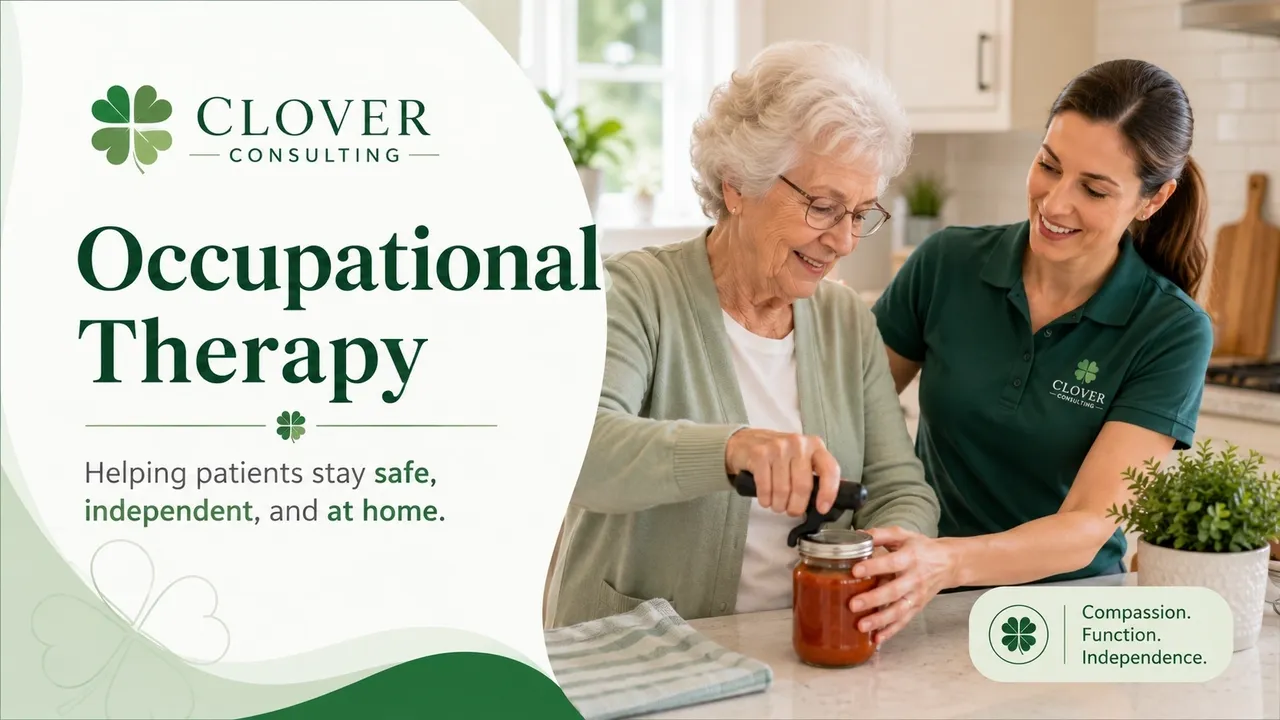
OT’s Role in Reducing Readmissions Under Value-Based Care
Why Function, Safety, and Real-World Independence Matter More Than Ever
In home health, we talk a lot about reducing hospital readmissions. We look at medication reconciliation, diagnosis management, discharge planning, follow-up appointments, fall risk, patient education, and caregiver support.
But one discipline that deserves more attention in the readmission conversation is occupational therapy.
OT is not just about helping a patient bathe, dress, or complete daily tasks. In a value-based environment, OT can be one of the most practical tools an agency has to reduce avoidable rehospitalizations, support safer transitions home, and prove the value of home health services.
A frequently cited study published in Medical Care Research and Review found that occupational therapy was the only hospital spending category where increased spending was statistically associated with lower readmission rates for heart failure, pneumonia, and acute myocardial infarction. A later systematic review with meta-analyses also found that OT interventions can reduce readmissions among adult hospitalized patients, with stronger evidence supporting transitional care interventions.
That matters because value-based care is no longer just about how many visits were provided. It is about whether the care helped the patient stay safe, stable, and out of the hospital.
Why OT Is Different
OT looks at the patient through a very real-world lens.
Can this patient safely get to the bathroom? Can they prepare a simple meal? Can they remember, access, and physically manage their medications? Can they use their walker in the actual layout of their home? Can they recognize safety risks? Can the caregiver safely assist without creating more risk for the patient or themselves?
These are not small questions. These are often the exact issues that lead to falls, medication errors, functional decline, caregiver breakdown, poor nutrition, missed follow-up care, and eventually readmission.
A patient may look “clinically stable” on paper but still be unsafe at home. OT helps bridge that gap between medical stability and actual day-to-day function.
OT Connects the Plan of Care to the Way the Patient Actually Lives
One of the strongest things OT brings to home health is the ability to assess function in the patient’s real environment.
That may include:
· Home safety assessments and recommendations
· ADL and IADL training
· Fall prevention strategies
· Adaptive equipment recommendations
· Energy conservation education
· Caregiver training
· Functional cognition assessment
· Medication management routines
· Bathroom, kitchen, and bedroom safety
· Training in safe transfers and daily routines
· Identifying whether the patient can safely remain in the home setting
This is where OT becomes more than a therapy discipline. OT becomes a readmission prevention strategy.
For example, a patient with heart failure may understand that they need to take daily weights, monitor symptoms, follow a low-sodium diet, and take medications correctly. But can they physically get to the scale? Can they read it? Can they record the weight? Can they identify when the number matters? Can they organize their routine around fatigue, shortness of breath, or limited endurance?
That is where OT can make the care plan real.
Functional Decline Is a Readmission Risk
After hospitalization, many patients return home weaker, less steady, more dependent, and less confident than they were before. Even when the acute condition has improved, the patient may still be at high risk because they cannot safely manage basic daily routines.
That functional decline can lead to a chain reaction:
A patient cannot safely bathe, so hygiene declines. They cannot prepare meals, so nutrition suffers. They cannot manage medications, so symptoms worsen. They cannot safely transfer, so fall risk increases. The caregiver becomes overwhelmed. The patient returns to the hospital.
OT is uniquely positioned to interrupt that chain.
The Value-Based Care Connection
Under value-based arrangements, agencies and referral partners are being judged by outcomes, not just activity.
CMS describes the Hospital Readmissions Reduction Program as a Medicare value-based purchasing program that encourages hospitals to improve communication and care coordination, engage patients and caregivers in discharge planning, and reduce avoidable readmissions. CMS has also described the Transforming Episode Accountability Model as an episode-based payment approach where participating hospitals receive a target price covering the hospital stay and certain post-discharge services, including post-acute care.
That means hospitals, systems, payers, and post-acute providers are all looking harder at what happens after discharge.
For home health agencies, this creates an opportunity.
If an agency can show that its OT services help reduce falls, improve safety, strengthen caregiver ability, improve medication routines, and support safe independence at home, that agency is not just providing visits. It helps protect outcomes under value-based care.
OT Should Not Be an Afterthought
Too often, OT is considered only after the patient is already struggling with bathing or dressing. But if the goal is to reduce readmissions, OT should be considered earlier and more strategically.
Patients who may benefit from OT include those with:
· Recent hospitalization
· New or worsening weakness
· Falls or near falls
· Medication management concerns
· Cognitive decline or poor safety awareness
· New assistive device use
· New oxygen use
· CHF, COPD, pneumonia, CVA, orthopedic conditions, or complex comorbidities
· Caregiver strain
· Difficulty with bathing, dressing, toileting, meal preparation, or household mobility
The question should not only be, “Can this patient walk?” The question should also be, “Can this patient safely live?”
That is where OT shines.
What Home Health Agencies Should Be Doing Now
Agencies that want to succeed under value-based care should look closely at how OT is being used.
Strong agencies should be asking:
Are we identifying OT needs early enough? Are clinicians documenting functional barriers clearly? Are OT interventions tied to readmission risks? Are we showing how OT supports medication safety, fall prevention, caregiver training, and safe daily routines? Are we connecting OT documentation to the patient’s diagnosis, functional limitations, and homebound status? Are we using OT as part of our transition-of-care strategy?
If OT is only documented as “ADL training,” the value may be missed. The documentation needs to show the skilled reasoning behind the visit and how OT is addressing risks that could lead to decline or rehospitalization.
The Bottom Line
Readmissions do not always happen because the patient lacked medical instructions. Sometimes they happen because the patient could not carry out those instructions safely in real life.
That is why OT matters.
OT helps turn a discharge plan into a livable plan. It helps identify what the patient can safely do, what support they need, what risks exist in the home, and what interventions can help the patient remain safe.
In a value-based world, that is not optional. It is essential.
Home health agencies that understand and document OT’s role well will be better positioned to show their value to referral partners, payers, patients, and families.
Because at the end of the day, reducing readmissions is not just about keeping patients out of the hospital.
It is about helping them safely stay where they want to be — at home.
