
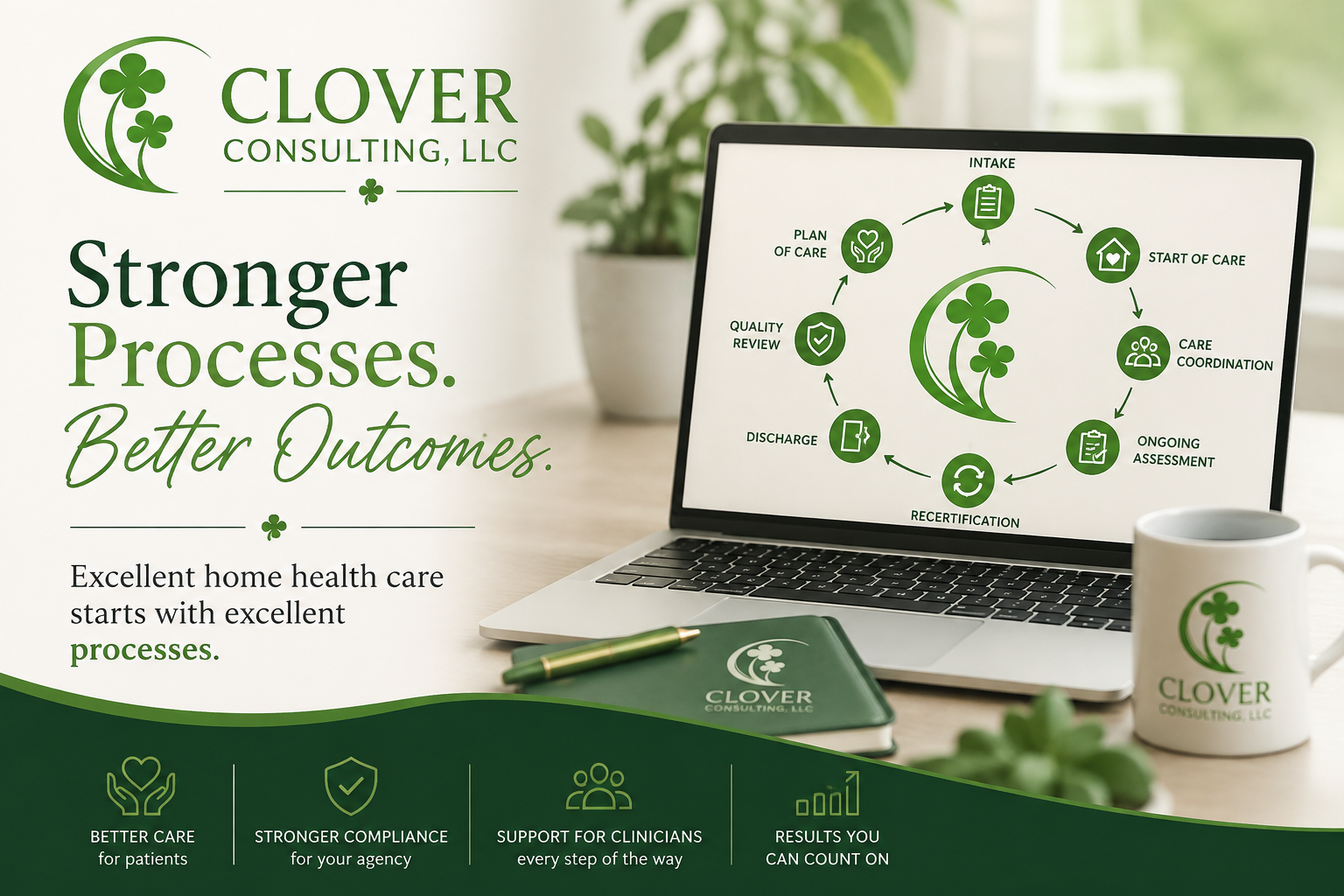
From Intake to Discharge: Why Strong Processes Are the Backbone of a Successful Home Health Agency
In home health, excellent clinical care does not happen in isolation. Behind every successful episode is a series of processes that begin long before the clinician walks through the patient’s door and continue until the final discharge is completed.
Referral intake. Eligibility verification. Face-to-face review. Scheduling. Start of care. OASIS. Coding. Plan of care development. Physician orders. Care coordination. Visit utilization. Quality review. Recertification. Discharge.
Each step connects to the next.
When those processes are well designed, clearly communicated, and consistently followed, an agency can operate with greater efficiency, stronger compliance, better patient outcomes, and fewer last-minute emergencies.
When they are not, small problems early in the episode tend to become much bigger problems later.
It Starts With Intake
Intake should never be viewed as simply entering a referral into the EMR.
It is the first opportunity to determine whether the agency has what it needs to safely and compliantly accept the patient.
A strong intake process asks important questions before admission:
- Does the patient meet Medicare home health eligibility requirements?
- Is there an appropriate qualifying face-to-face encounter?
- Does the documentation support the primary reason for home health?
- Are the ordered services appropriate?
- Is the agency able to safely meet the patient’s needs?
- Are there wounds, IV medications, high-risk diagnoses, equipment needs, or other clinical concerns that require additional planning?
- Are referral documents complete?
- Is additional information needed before the start of care?
When these questions are addressed at intake, clinicians are not left trying to solve missing information from the patient’s living room.
Strong intake processes protect both the patient and the agency.
The Start of Care Sets the Direction for the Entire Episode
The Start of Care is much more than completing an OASIS assessment.
It establishes the clinical foundation for everything that follows.
The clinician must identify why the patient requires home health, what skilled services are necessary, what functional and clinical risks exist, what the patient hopes to accomplish, and what interventions will be required to move the patient toward those goals safely.
The OASIS, clinical narrative, diagnoses, medication profile, plan of care, orders, therapy findings, hospitalization risk, homebound status, and physician documentation should tell the same clinical story.
When they do not, agencies often see downstream problems:
- Coding inconsistencies
- Unsupported diagnoses
- Weak homebound documentation
- Plans of care that do not reflect the patient’s actual needs
- Missing or delayed orders
- Inappropriate utilization
- Documentation deficiencies
- Claim delays or denials
- Increased audit risk
A strong Start of Care process includes both clinical assessment and quality review before the episode gets too far down the road.
Finding a problem on Day 3 is far easier than trying to correct it on Day 45.
Standardization Does Not Mean Removing Clinical Judgment
Sometimes clinicians hear the word process and immediately think of more boxes to check.
That should never be the goal.
Good processes create structure while still allowing clinicians to use their professional judgment.
For example, an agency may standardize its expectations for hospitalization-risk education while still requiring clinicians to individualize that education based on the patient’s diagnoses, medications, functional limitations, caregiver availability, and specific risk factors.
The process creates consistency.
The clinician provides the individualized care.
Both are necessary.
Care Coordination Cannot Be an Afterthought
Home health is one of the most collaborative environments in healthcare.
Nursing, physical therapy, occupational therapy, speech therapy, social work, home health aides, physicians, caregivers, office staff, coding, quality, and operations may all contribute to a single episode.
Without defined communication processes, important information can become fragmented.
A therapist identifies orthostatic symptoms but assumes nursing knows.
Nursing identifies medication discrepancies but does not communicate them to therapy.
The physician changes a medication, but the plan of care is not updated.
A patient begins declining functionally, but no one evaluates whether the current frequency remains appropriate.
The solution is not simply telling staff to “communicate better.”
Agencies need systems that define:
- What information must be communicated
- Who needs to receive it
- How quickly communication should occur
- Where that communication is documented
- Who is responsible for follow-up
Reliable care coordination should be built into the agency’s workflow—not dependent on someone remembering to send a message.
Utilization Should Follow the Patient’s Needs
Another critical process occurs throughout the episode: utilization review.
Visit frequency should not simply continue because “that is what was ordered at SOC.”
The patient’s condition changes.
Their ability to manage medications improves.
Their wound may progress—or deteriorate.
Their endurance may improve.
Their caregiver may become unavailable.
New risks may develop.
An effective utilization process evaluates whether the current level of service continues to be reasonable and necessary based on the patient’s documented condition and progress.
Clinical documentation, goals, interventions, visit frequency, and continued skilled need should remain aligned throughout the episode.
This helps agencies avoid both sides of the utilization problem: providing services that are no longer supported and discharging or reducing services before the patient is clinically ready.
Orders and Documentation Need Their Own Process
Few things create more unnecessary chaos than unresolved orders.
Unsigned plans of care.
Verbal orders waiting for signatures.
Medication changes that were never incorporated.
Frequency changes that were discussed but never formally ordered.
These issues are rarely caused by one person. They are usually evidence of a process without clearly defined ownership.
Every agency should be able to answer:
Who tracks outstanding orders, how frequently are they reviewed, when are they escalated, and what happens when the physician does not respond?
If that answer depends on who happens to be working that day, the process needs strengthening.
Discharge Planning Begins at Admission
One of the biggest mistakes agencies make is waiting until the final week of care to start thinking about discharge.
Discharge planning should begin at the Start of Care.
What needs to happen before this patient can safely manage without home health?
What does the patient need to learn?
What must improve functionally?
What should the caregiver be able to demonstrate?
What community resources may be needed?
What risks need to be mitigated?
When goals are specific and measurable from the beginning, clinicians can demonstrate progress throughout the episode and prepare patients for discharge rather than surprising them with it.
A strong discharge process also ensures the final documentation accurately reflects the patient’s status, progress, remaining needs, education provided, medication reconciliation, follow-up plan, and transition to the next level of care.
Your Processes Should Create a Closed Loop
The strongest home health organizations do not think of their workflows as isolated departments.
They create a closed loop:
Referral → Intake → Eligibility → Start of Care → OASIS/Coding Review → Plan of Care → Orders → Clinical Visits → Care Coordination → Utilization Review → Quality Oversight → Recertification or Discharge → Performance Review
And then something very important happens.
The organization learns from what occurred.
Why are clinicians repeatedly missing the same documentation element?
Why are orders consistently delayed?
Why are patients from a particular referral source arriving without required documentation?
Why are certain patients being hospitalized?
Why are episodes consistently exceeding anticipated utilization?
Why are clinicians struggling with a particular OASIS item?
Those findings should feed back into education, policy, workflow changes, and QAPI.
That is how an agency moves from fixing individual charts to improving the system that creates the charts.
Processes Protect Your Clinicians, Too
Strong processes are not only about regulatory compliance.
They make clinicians’ jobs easier.
When expectations are unclear, clinicians spend enormous amounts of time:
- Searching for information
- Reworking documentation
- Responding to chart corrections
- Tracking down orders
- Asking who is responsible for the next step
- Correcting issues that could have been prevented earlier
That frustration contributes to burnout.
A well-designed process removes unnecessary decision-making and administrative burden so clinicians can spend more time doing what they were hired to do: care for patients.
Compliance Should Be Built Into the Workflow
Survey readiness should never begin when the surveyor walks through the door.
Audit readiness should not begin when an ADR arrives.
Compliance should be built into everyday operations.
The goal is not to create a perfect chart because someone may eventually review it.
The goal is to create a reliable system in which compliant, clinically meaningful documentation is the expected result of the normal workflow.
When that happens, survey readiness becomes less of an event and more of an organizational habit.
The Bottom Line
Home health agencies do not usually struggle because their employees do not care.
Many struggle because good people are working inside inconsistent systems.
Excellent processes provide the structure that allows excellent employees to succeed.
From the moment a referral arrives until the moment the patient is discharged, every handoff matters. Every department matters. Every step influences the next.
The agencies that thrive will be the ones that stop looking at intake, clinical operations, OASIS, coding, quality, utilization, orders, and discharge as separate functions and begin managing them as one connected patient-care journey.
Because in home health, quality is not one department’s responsibility.
It is the result of the process from beginning to end.
Clover Consulting, LLC
At Clover Consulting, we help home health agencies evaluate the processes behind the documentation—not just the documentation itself. From OASIS and coding review to clinical workflows, utilization management, compliance, survey readiness, and clinician education, our goal is to help agencies build systems that are practical, sustainable, and defensible.
Better processes. Stronger documentation. Better outcomes.
