
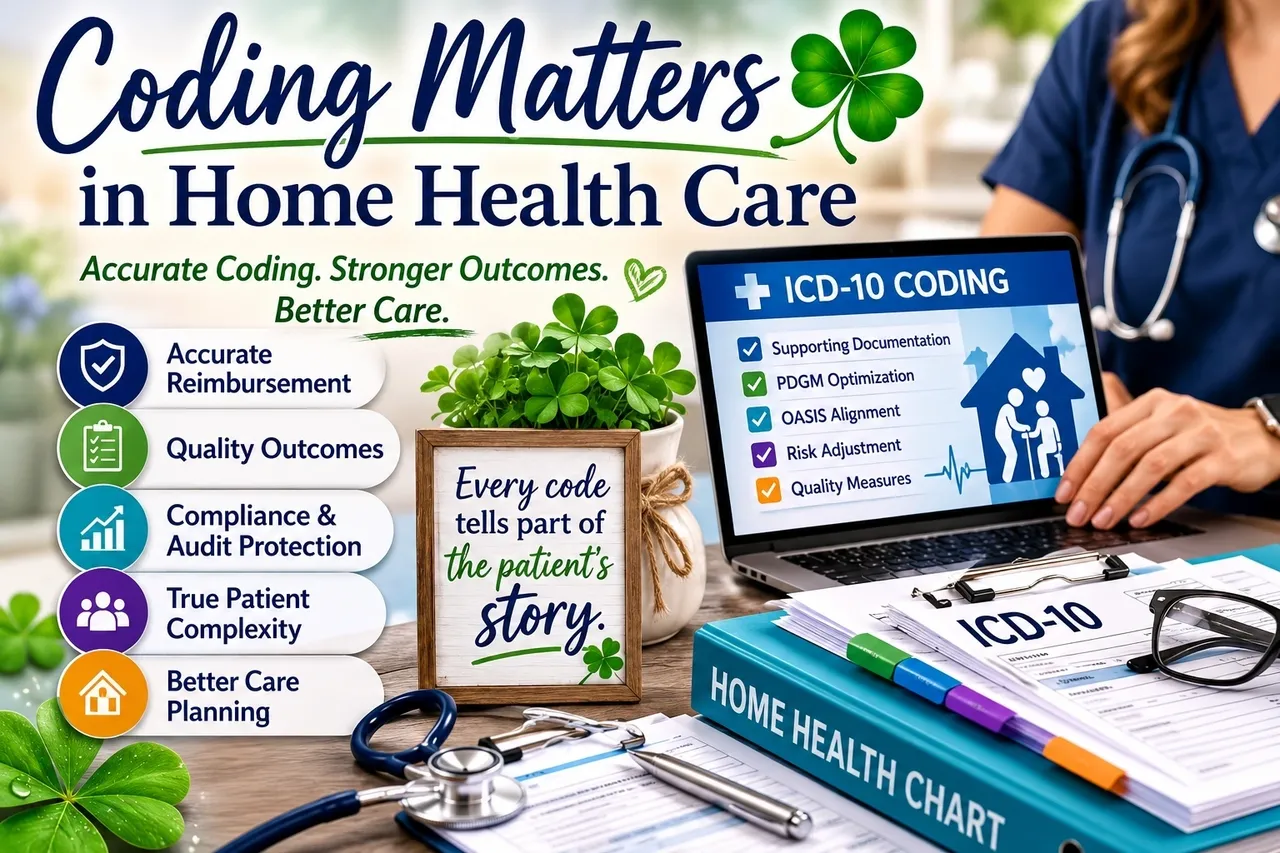
The Hidden Backbone of Home Health: Why Accurate Coding Matters
In home health care, coding is often viewed as a billing function.
But in reality, accurate coding impacts nearly every part of agency operations — from reimbursement and quality outcomes to compliance risk and patient care planning.
Every diagnosis code tells part of the patient’s story.
And when that story is incomplete, unsupported, or inaccurately sequenced, the consequences can affect far more than payment.
Coding Impacts More Than Revenue
Accurate coding directly influences:
- PDGM reimbursement
- Quality measure outcomes
- HHVBP performance
- Risk adjustment accuracy
- Hospitalization data
- Care coordination
- Survey readiness
- ADR and denial risk
- OASIS accuracy
- Interdisciplinary documentation consistency
Coding is no longer a back-office task isolated from clinical operations.
It is a core compliance and quality function.
Common Coding Problems Agencies Continue to Face
Many agencies are still struggling with:
Diagnoses Not Supported in Documentation
A diagnosis may appear in the chart, but if it is not addressed, monitored, treated, or impacting care, it may not be defensible during audit review.
Chronic Conditions Being Omitted
Conditions such as COPD, CHF, CKD, diabetes complications, depression, or neuropathy are often left off the claim despite significantly affecting patient outcomes and risk adjustment.
Incorrect PDGM Sequencing
Primary diagnosis selection can dramatically impact reimbursement grouping and clinical grouping assignment.
OASIS and Coding Misalignment
One of the most common audit concerns is inconsistency between:
- OASIS responses
- Visit documentation
- Coding
- Plan of care
- Functional scoring
When documentation tells conflicting stories, agencies become vulnerable to denials and survey deficiencies.
“Copy and Paste” Coding Habits
Repeated carryover diagnoses without current clinical support remain a major compliance concern.
Coding should reflect the patient’s current condition and skilled needs during the certification period.
Why Coding Accuracy Matters Under PDGM and HHVBP
As value-based care expands, coding accuracy becomes even more critical.
Risk adjustment models rely heavily on accurate diagnosis reporting.
Missed or unsupported diagnoses can affect:
- Outcome calculations
- Hospitalization risk measures
- Functional outcome comparisons
- HHVBP scoring
- Expected resource use
Inaccurate coding can unintentionally make agency outcomes appear worse than they truly are.
Coding and Clinical Collaboration Must Work Together
Strong agencies understand that coding accuracy cannot happen in isolation.
Success requires collaboration between:
- Clinicians
- QA reviewers
- Coders
- Therapy
- Intake
- Leadership
The strongest outcomes occur when documentation, coding, and OASIS all align to accurately reflect patient complexity and skilled need.
The Financial Cost of Poor Coding
Coding errors can create:
- Lost reimbursement opportunities
- Increased ADRs
- Medical review denials
- Returned claims
- Delayed billing
- HHVBP score declines
- Increased survey risk
But perhaps most importantly, poor coding creates an inaccurate clinical picture of the patient.
The Future of Home Health Requires Stronger Coding Processes
As CMS continues expanding value-based reimbursement models and increasing scrutiny on documentation defensibility, agencies that invest in coding education and strong QA processes will be better positioned for long-term success.
Accurate coding is not simply about “getting paid.”
It is about:
☘️ Supporting medical necessity
☘️ Capturing patient complexity appropriately
☘️ Improving quality outcomes
☘️ Reducing compliance risk
☘️ Strengthening interdisciplinary care planning
☘️ Protecting agency sustainability
The agencies that thrive moving forward will be the ones that treat coding as a strategic clinical and compliance priority — not just a billing task.
