
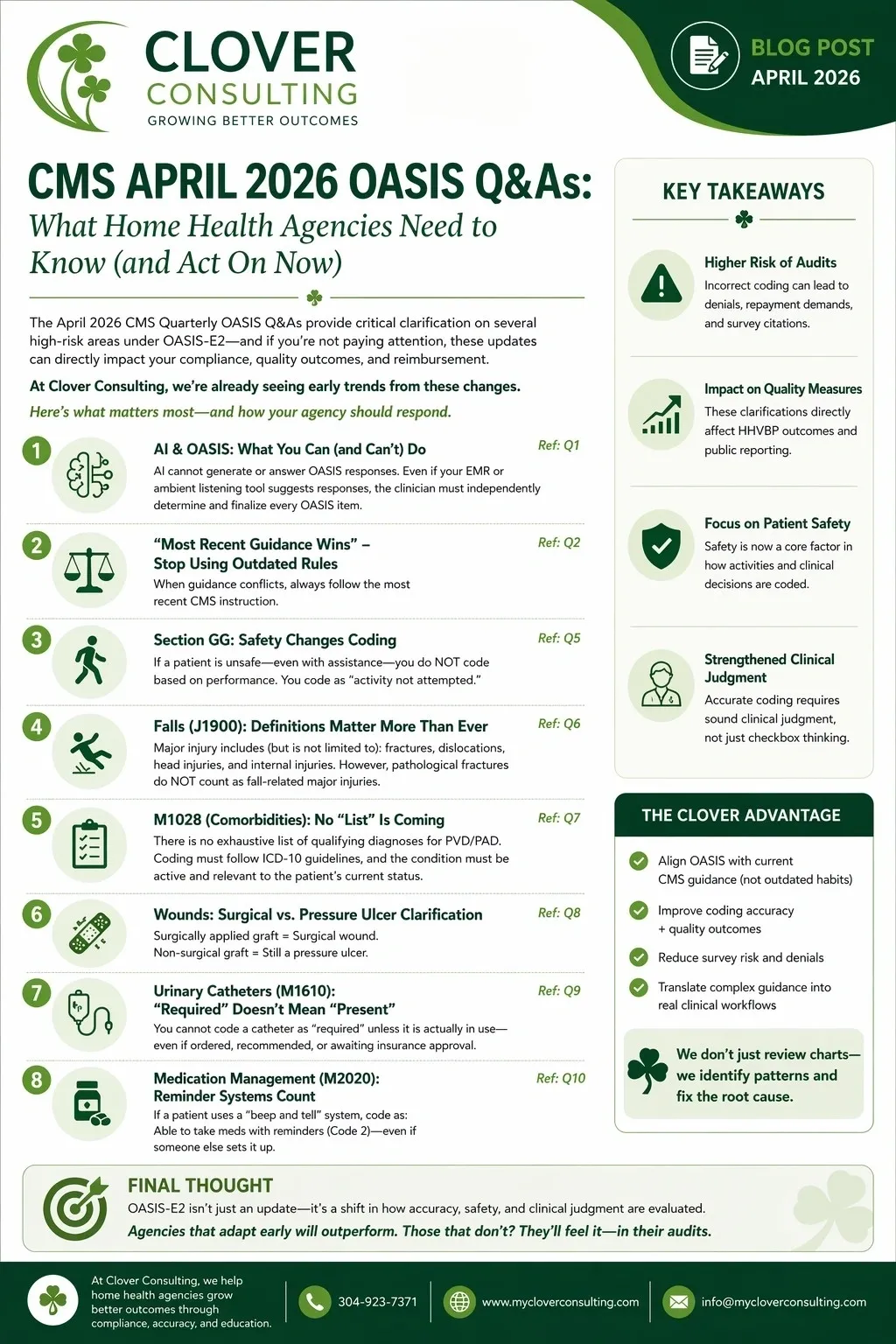
CMS April 2026 OASIS Q&As: What Home Health Agencies Need to Know
The April 2026 CMS Quarterly OASIS Q&As provide critical clarification on several high-risk areas under OASIS-E2—and if you’re not paying attention, these updates can directly impact your compliance, quality outcomes, and reimbursement.
At Clover Consulting, we’re already seeing early trends from these changes. Here’s what matters most—and how your agency should respond.
1. AI & OASIS: What You Can (and Can’t) Do
CMS made this crystal clear:
AI cannot generate or answer OASIS responses.
Even if your EMR or ambient listening tool suggests responses, the clinician must independently determine and finalize every OASIS item.
What this means for your agency:
- AI can support (scrubbing, documentation capture, prompts)
- AI cannot decide or auto-populate final answers
- The clinician owns the assessment—period
Risk Alert 🚨:
If your workflow allows AI to “pre-fill” answers without true clinician validation, you are at risk for survey deficiencies.
2. “Most Recent Guidance Wins” – Stop Using Outdated Rules
CMS confirmed that when guidance conflicts:
Always follow the most recent CMS instruction.
Why this matters:
Many agencies are still:
- Training from outdated manuals
- Following older Q&As
- Missing newer clarifications
Clover Insight:
This is exactly how agencies end up with systemic audit findings—not just one-off errors.
3. Section GG: Safety Changes Coding
A major clarification that will impact your scoring:
If a patient is unsafe—even with assistance—:
➡️ You do NOT code based on performance
➡️ You code as “activity not attempted”
Real-world impact:
- Overstating function = quality measure risk
- Understating safety concerns = patient risk + survey risk
Bottom line:
Safety is now a determining factor—not just ability.
4. Falls (J1900): Definitions Matter More Than Ever
CMS reinforced:
- “Major injury” includes (but is not limited to):
- Fractures
- Dislocations
- Head injuries
- Internal injuries
BUT here’s the nuance agencies are missing:
👉 Pathological fractures do NOT count as fall-related major injuries
Why this is a big deal:
Incorrect coding here directly impacts:
- Falls with Major Injury measure
- HHVBP performance
- Public reporting
Clover Tip:
Your clinicians need more than definitions—they need decision-making guidance.
5. M1028 (Comorbidities): No “List” Is Coming
If you’re waiting for CMS to give you a list of qualifying diagnoses for PVD/PAD…
👉 It’s not happening.
CMS confirmed:
- There is no exhaustive list
- Coding must follow ICD-10 guidelines
- The condition must be active and relevant to the patient’s current status
What this means:
This is no longer a “checkbox” item—it’s a clinical judgment + coding accuracy test
6. Wounds: Surgical vs. Pressure Ulcer Clarification
A key distinction:
- Surgically applied graft → Surgical wound
- Non-surgical graft → Still a pressure ulcer
Why agencies get this wrong:
- Misclassification impacts:
- OASIS accuracy
- Quality reporting
- Survey outcomes
7. Urinary Catheters (M1610): “Required” Doesn’t Mean “Present”
CMS clarified:
👉 You cannot code a catheter as “required” unless it is actually in use
Even if:
- It’s ordered
- It’s recommended
- Insurance hasn’t approved it yet
This is a common error:
Agencies are coding based on plans instead of reality on assessment day
8. Medication Management (M2020): Reminder Systems Count
If a patient uses a “beep and tell” system:
➡️ Code as:
Able to take meds with reminders (Code 2)
Even if:
- Someone else sets it up
- It’s set weekly or daily
What This Means for Your Agency
These aren’t minor clarifications—these are practice-changing updates.
If your agency:
- Hasn’t updated training
- Isn’t auditing for these changes
- Relies heavily on EMR prompts or AI
👉 You are likely already seeing accuracy gaps
How Clover Consulting Helps
At Clover, we don’t just review charts—we identify patterns and fix the root cause.
We help agencies:
- Align OASIS with current CMS guidance (not outdated habits)
- Improve coding accuracy + quality outcomes
- Reduce survey risk and denials
- Translate complex guidance into real clinical workflows
Final Thought
OASIS-E2 isn’t just an update—it’s a shift in how accuracy, safety, and clinical judgment are evaluated.
Agencies that adapt early will:
✔ Perform better in HHVBP
✔ Reduce compliance risk
✔ Strengthen documentation integrity
Those that don’t?
They’ll feel it—in their audits.
